
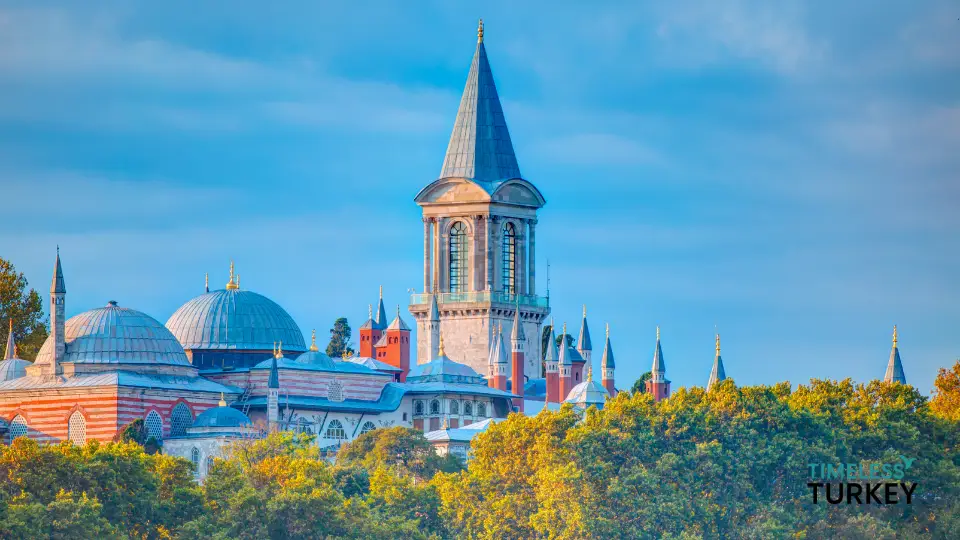
Istanbul’s historic peninsula holds a memory that has defied centuries at Sarayburnu, where the Bosphorus embraces the Sea of Marmara. This is the Topkapi Palace Museum, the residence of Ottoman Sultans who ruled over three continents, the administrative center of the state, and one of the world’s richest archives.
From Sultan Mehmed the Conqueror to Sultan Abdülmecid, the heart of the empire beat here for approximately 400 years. Unlike the European extravagance of Dolmabahçe Palace, Topkapi Palace Museum stands as a different world entirely—modest yet dignified, with its interconnected courtyards and deeply buried secrets. In this comprehensive guide by Timeless Turkey, we explore the mysteries of the Harem, the spiritual atmosphere of the Sacred Relics, the brilliance of the Spoonmaker’s Diamond, and the essential details to make your visit perfect.
The Heart of a World Empire and Its History
The Dream of the Conqueror: Saray-ı Cedid
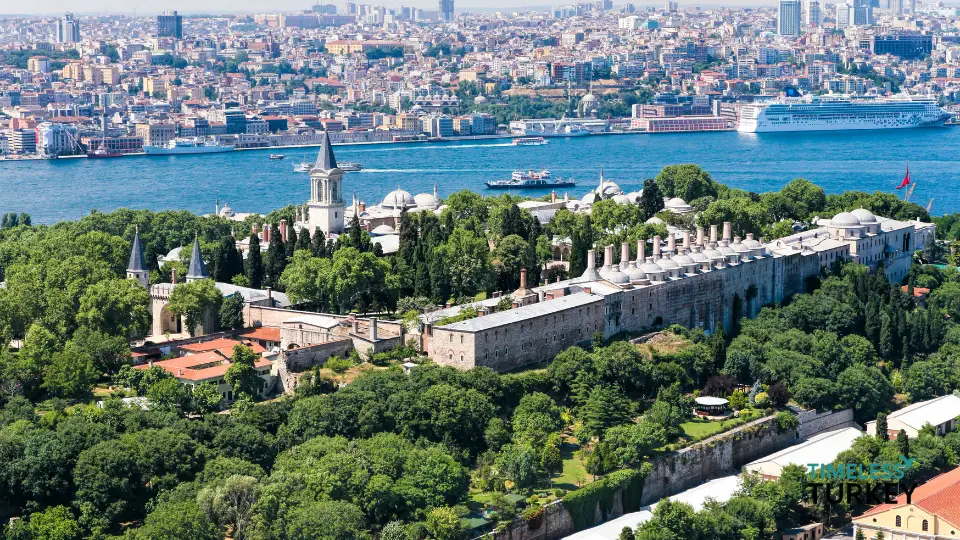
After the conquest of Istanbul, Mehmed the Conqueror first settled in the “Old Palace” (located where Istanbul University stands today). However, he later ordered the construction of a new palace on this hill—the site of the ancient Byzantine acropolis—the most strategic point in the city. Construction of the Topkapi Palace Museum began in 1460 and was completed in 1478. At the time, it was called “Saray-ı Cedid-i Amire” (The New Imperial Palace). The name “Topkapi” (Cannon Gate) was adopted later by the public due to the cannons located at the shoreline gate.
Four Courtyards, Four Different Worlds
The Topkapi palace is not a single building but a massive complex consisting of four sequential courtyards:
- The First Courtyard (Alay Meydanı): The only area accessible to the general public during the empire. The Hagia Irene Church is located here.
- The Second Courtyard (Divan Meydanı): The administrative hub. The Divan-ı Hümayun (Imperial Council) met here, where the viziers of the dome made critical decisions. The palace kitchens are also located in this courtyard.
- The Third Courtyard (Enderun Avlusu): The Sultan’s private domain. It houses the Audience Chamber (where foreign ambassadors were received) and the Enderun School (the elite school for statesmen).
- The Fourth Courtyard (Sofa-i Hümayun): The innermost terrace where Sultans relaxed among tulip gardens and pavilions like the Baghdad and Revan Kiosks, offering the most stunning views of the city.
The Harem: A Golden Cage or a School?
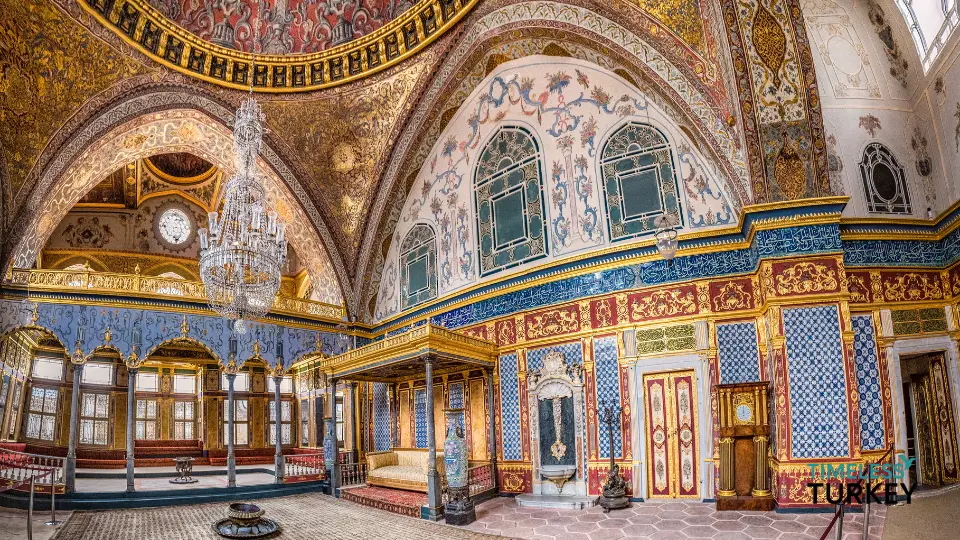
The most intriguing part of the Topkapi Palace Museum is undoubtedly the Harem. Often depicted by Western orientalists as a place of “debauchery,” the Harem was actually a highly disciplined educational institution governed by strict military-like order. As the Sultan’s private home, it was managed by the Valide Sultan (Queen Mother). Here, concubines received education in music, literature, and embroidery. Architecturally, the Courtyard of the Black Eunuchs, the Imperial Hall, and the Twin Kiosks are the most breathtaking spots.
Sacred Relics and the Spoonmaker’s Diamond
The spiritual center of the palace is the Chamber of Holy Relics (Has Oda), established after Sultan Selim I’s Egyptian campaign. The mantle of Prophet Muhammad (PBUH), his sword, and relics of other prophets are preserved here. A 500-year-old tradition of continuous Quran recitation (24/7) still continues today. On the side of material wealth, the 86-carat Spoonmaker’s Diamond and the emerald-encrusted Topkapi Dagger in the Treasury section stand as tangible symbols of imperial power.
Timeless Turkey Advices
- Extra Ticket for the Harem: Many visitors assume the Harem is included in the main palace ticket. Usually, it requires a separate ticket or a “Combined Ticket.” Our advice: Absolutely buy the Harem ticket. You haven’t truly seen the palace until you’ve walked through those narrow corridors and the Valide Sultan’s chambers.
- Avoid the Tuesday Trap: The Topkapi Palace Museum is closed on Tuesdays. Don’t let your travel plans be ruined by this detail. Weekends are incredibly crowded; the ideal time to visit is Wednesday or Thursday at the opening hour (09:00).
- Prioritize the Treasury and Sacred Relics: If you enter right at opening time, head straight to the 3rd Courtyard for the Sacred Relics and the Imperial Treasury before the crowds arrive. Massive queues form here by noon. You can explore the gardens and kitchens later at a slower pace.
- Don’t Skip Hagia Irene: Located in the first courtyard near the ticket booths, Hagia Irene is one of the few Byzantine churches never converted into a mosque. Its acoustics are legendary. If you have a combined ticket, make sure to step inside.
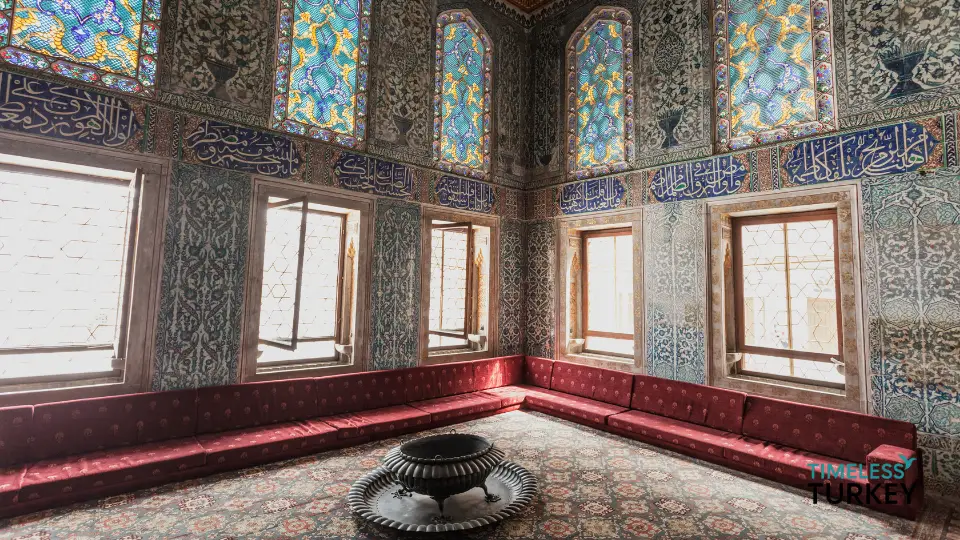
- Photography Spots: For the best photos, head to the terrace in the 4th Courtyard. The view of the Bosphorus and the Maiden’s Tower from the Konyalı side is unmatched. Also, the Iznik tiles in the Circumcision Room provide a stunning backdrop for detail shots.
- What to Eat: While we won’t name specific cafes, we recommend trying traditional Ottoman sherbets or a simple Turkish coffee at the palace’s terrace restaurant to soak in the historical atmosphere.
Frequently Asked Questions (FAQ)
Where is Topkapi Palace Museum?
The palace is located in the Sultanahmet neighborhood of the Fatih district, at the very tip of Istanbul’s historic peninsula.
How to get to Topkapi Palace Museum?
- Tram: Take the T1 (Bağcılar-Kabataş) line and get off at “Sultanahmet” or “Gülhane.”
- Marmaray: Get off at the “Sirkeci” station. It’s a 10-15 minute walk via the Cağaloğlu slope or through Gülhane Park.
- Ferry: You can take a ferry to Eminönü and then walk for 20 minutes or transfer to the T1 tram.
- Private Car: Driving is not recommended as Sultanahmet is mostly closed to traffic. Use parking lots in Eminönü or Sirkeci.
What is the Topkapi Palace Museum entry fee for 2026?
Ticket prices vary for local and international visitors. “Combined Tickets” (Palace + Harem + Hagia Irene) are available. Since prices are subject to updates, please check the official Milli Saraylar (National Palaces) website for the most current rates. For Turkish citizens, the Müzekart remains the most economical option.
Is Müzekart valid at Topkapi Palace Museum?
Yes, Müzekart is valid for Turkish citizens, but with specific limitations.
- Where Müzekart is NOT valid: The Harem Department and Hagia Irene Church are generally excluded from the standard Müzekart. You may need a “Müzekart Plus” or a separate ticket for these sections.
- Where Müzekart IS valid: You can use it to enter the main courtyards, the Imperial Council (Divan), the Kitchens, the Treasury, and the Sacred Relics section twice a year.
Which days is the palace closed?
The Topkapi Palace Museum is closed to visitors every Tuesday. It may also be closed until noon on the first day of religious holidays.
What are the visiting hours?
- Summer Term (April 1 – October 1): 09:00 – 18:00 (Ticket booths close at 17:00).
- Winter Term (October 1 – April 1): 09:00 – 17:00 (Ticket booths close at 16:00).
Is a separate ticket required for the Harem?
Yes, the Harem section is not included in the general admission. You must either purchase a “Combined Ticket” at the main entrance or buy a separate Harem ticket at the internal ticket booth located at the Harem entrance.
Is there a dress code for Topkapi Palace Museum?
While there is no strict code for the gardens, there is a strict dress code for the Sacred Relics Department (Has Oda). Visitors wearing shorts, miniskirts, or sleeveless tops are not allowed inside due to the spiritual significance of the relics. Shawls are usually provided at the entrance for covering up.
Who can enter Topkapi Palace for free?
The following groups (Turkish citizens) can generally enter for free (excluding the Harem):
- Citizens aged 18 and under or 65 and over.
- Veterans and relatives of martyrs/veterans.
- Disabled citizens with one companion.
- Soldiers (Er and Erbaş).
- Holders of a valid Müzekart.